EPA seeking public comments on the T-25 South site

The U.S. Environmental Protection Agency (EPA) requests public comment on the cleanup alternatives for the T-25 South (T-25S) site area. Public comment begins January 26, 2026.
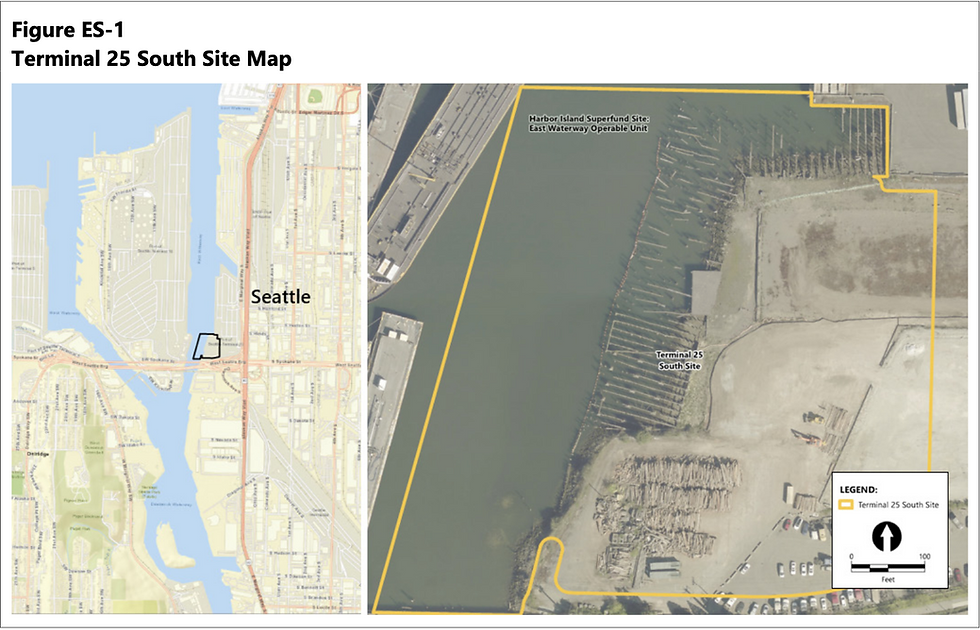
The T-25S site is located along the southeast portion of the East Waterway Operable Unit of the Harbor Island Superfund site in Seattle. The T-25S site is north of the Spokane Street Bridge, partially within the East Waterway, which is about one mile south of downtown Seattle. See below:

What are the contaminants of concern at the T-25S Site?
Previous investigations of sediment and soil at the T-25S site identified polychlorinated biphenyls as the primary contaminant of concern, although polycyclic aromatic hydrocarbons, and dioxins/furans are also present.
What is needing public comment?
EPA is accepting comments on the T-25S site engineering evaluation and cost analysis (EE/CA), which has a goal of promptly reducing exposure risks to human health and the environment. The T-25S site EE/CA proposes three cleanup alternatives (detailed below) to address contaminated sediments and soils within the in-water and upland portions. Each cleanup alternative includes varying amounts of removal, backfill, and capping any remaining contamination. Following the removal action, the Port of Seattle will construct a habitat project at the T-25S site that will restore habitat, by creating an off‐channel marsh and restored shoreline for fish and wildlife habitat.
Please visit EPA’s Harbor Island website for more information about the T-25S site EE/CA and to provide public comments: www.epa.gov/superfund/harbor-island
EPA will accept public comments on the T-25S site Engineering Evaluation / Cost Analysis starting January 26, 2026, through Thursday, March 12, 2026.
How to provide public comments: EPA invites public review and comments on all the cleanup alternatives for the T-25S site area. You may provide public comments by March 12, 2026 in the following ways:
By E-mail: Region10@epa.gov
By Mail: ATTN: T-25S Site EE/CA, c/o Laura Knudsen, U.S. EPA Region 10, 1200 Sixth Avenue, Suite 155, Superfund Records Center, Mail Stop 17-C04-1, Seattle, WA 98101
Questions? Contact Laura Knudsen, EPA Community Involvement Coordinator at 206-553-1838 or knudsen.laura@epa.gov.
Detailed information:
EPA anticipates the T-25S site cleanup will begin in 2028.
EPA’s preferred cleanup alternative (Alternative 3, below) for the T-25S site includes:
Removal of all pilings and other debris from the in-water portion of the site, followed by dredging between 3 and 11 vertical feet of sediments with contamination exceeding the Remedial Action Levels (RALs) established for the East Waterway.
Full excavation of upland soils with contamination greater than the East Waterway RALs.
After dredging and excavation, removed material will be disposed according to applicable regulations.
Clean material will replace all dredged and excavated areas, with a sand layer cover in dredged areas, a rock armor layer placed along the subtidal slope, and clean fill placed to construct the mudflat and marsh habitat area.
Removal Action Alternatives
Three alternatives were developed for the T-25S Site to address sediment and soil contamination and achieve the RAO. The removal action areas were delineated using Thiessen data interpolation to identify the lateral and vertical extents of areas greater than the EW RALs. The Thiessen polygons were further grouped into dredge units (DUs) or excavation units (EUs) based on similar removal depths and/or similar type of contamination. For the in-water portion of the T-25S Site, only one in-water alternative is considered in order to be consistent with the EW IROD. Three alternatives for the upland portion of the T-25S Site consider a range of lateral and vertical extents of contaminated soil removal, backfill, and capping. Though not required by EPA as part of the NTCRA, all alternatives include some excavation of soils without EW RAL exceedances down to required habitat subgrade elevations, followed by placement of clean 2-foot backfill that will occur in certain areas.
Alternative 1
Alternative 1 includes partial excavation of 11.5 feet of upland contaminated soil in the area with the highest EW RAL exceedances (primarily the highest PCB RAL exceedances) and NAPL presence, followed by placement of an amended cap (composed of a 0.5-foot-thick organoclay-amended sand for NAPL sorption and a 1-foot-thick granular activated carbon [GAC]-amended sand for chemical isolation), and an average of 5.2 feet of clean backfill (atop the cap) to reach final habitat design elevations. Alternative 1 also includes partial excavation of contaminated soils in other focused upland areas to address EW RAL exceedances, followed by 2 feet of clean backfill placement to achieve final habitat design elevations. Consistent with the EW IROD, the in-water portion includes removal of
debris and pilings to the maximum extent practicable, dredging of contaminated sediments, followed by RMC and placement of sloped backfill and armor.
Alternative 1 is considered effective in the long- and short-term, and is easily implementable, with an anticipated construction timeframe of 14 working months.3 The total estimated cost for this alternative is approximately $88.5 million, approximately $46.1 million to address the in-water sediments, and approximately $42.4 million to implement the removal action in the upland portion of the T-25S Site.
Alternative 2
Alternative 2 includes partial excavation of 13.5 feet of upland contaminated soil in the area with the highest EW RAL exceedances (primarily the highest PCB RAL exceedances) and presence of NAPL, followed by placement of an amended cap (composed of a 0.5-foot-thick organoclay-amended sand for NAPL sorption, and a 1-foot-thick GAC-amended sand for chemical isolation), and an average of 7.2 feet of clean backfill (atop the cap) to reach final habitat design elevations. Partial excavation of contaminated soils in other focused upland areas will address EW RAL exceedances down to required habitat subgrade elevations, followed by placement of a 1-foot-thick GAC-amended cap and 2 feet of clean backfill. The in-water action for this alternative is the same as Alternative 1.
Alternative 2 is considered effective in the long- and short-term, and is easily implementable, with an anticipated construction timeframe of 14.6 working months. The total estimated cost for this alternative is approximately $91.9 million, approximately $46.1 million for the in-water portion and approximately $45.8 million to implement the removal action in the upland portion of the T-25S Site.
Alternative 3 (EPA's preferred Alternative)
Alternative 3 includes full excavation of upland contaminated soils in the area with the highest EW RAL exceedances and presence of NAPL (down to 16 feet bgs) and in other upland areas to address soil contamination with concentrations greater than the EW RALs, followed by clean backfill placement to achieve final habitat design elevations. The in-water action for this alternative is the same as Alternative 1.
Alternative 3 is considered effective in the long- and short-term, and is easily implementable, with an anticipated construction timeframe of 16.1 working months. The total estimated cost for this alternative is approximately $99.0 million, approximately $46.1 million for the in-water portion, and approximately $52.9 million to implement the removal action in the upland portion of the T-25S Site.


Comments